(These are excerpts from my book "A History of Jazz Music")
(You can also listen to a playlist of this chapter)
New York: Stride piano
TM, ®, Copyright © 2003 Piero Scaruffi All rights reserved.
One of the most significant innovations in the early history of jazz music was
the dramatic transformation of piano playing that took place as jazz migrated
from New Orleans to Chicago to New York, the capital of ragtime. In 1920,
as the 25-year old fad of ragtime was beginning to wane and the blues was
becoming the new fad,
New York's jazz pianist began to blend blues and ragtime.
The sound that resulted from that fusion was dense and loud, and came to
be called "stride" piano.
The place where the synthesis took place might actually have been Atlantic
City.
Before World War I
that was the city where pianists from all over the country converged
during the summer to entertain the guests of the various establishments of
the red-light district. Pianists who performed in Atlantic City included
Eubie Black from Baltimore (from 1906), Luckey Roberts from Philadelphia,
Willie "The Lion" Smith and James Johnson (1914) from New York.
When the summer season was over, most of these pianists would move to Harlem,
the black ghetto of New York, where an entire subculture of night-clubs for
black people was booming. In the 1920s, following the vogue of blues music,
Harlem was invaded by the white tourists, who came to check out the exotic
music of the blacks. So those clubs (and their performers) began to cater to
a white audience.
They authentic black-piano experience (and innovation) moved to the
"rent parties", i.e. parties meant to raise money to pay rent, that became
extremely popular after the end of World War II among poor black tenants of
Harlem. Those were the years when "stride" piano came into its own.
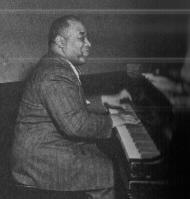
Philadelphia-born
Charles "Luckey" Roberts was in many ways
the "founder" of the New York school of pianists.
He was the first Harlem pianist to be published (Junk Man Rag, 1913)
and recorded (october 1916). His most famous and difficult tune was Ripples of the Nile (1912), reworked as Moon Light Cocktail (may 1942) for Glenn Miller. He also composed classical music: a three-movement Spanish Suite (1939), and
the "miniature syncopated rhapsody" for piano and orchestra Whistlin' Pete (1941).
Jazz music appropriated the instruments that were popular in the community,
such as the brass bands of New Orleans. New York (and particularly Harlem,
that was rapidly becoming a black ghetto) did not have a musical culture
based on brass bands but rather one based on the piano, an instrument that
had become extremely popular everywhere during the first decade, and even so
in the big cities of the Northeast. Of course, ragtime was the main driver
for piano sales in New York.
Ragtime pianist and composer Eubie Blake best represents the link
between ragtime and "stride". The latter was a style that developed in response
to the need of providing both rhythm and melody: the left hand was in charge
of the beat, but it was allowed to "stride" all over the keyboard to enliven
the piece,
while the right hand improvised difficult melodic figures.
Stride piano produced an "orchestral" sound, the sound of pianists
who could not afford a backing band.
Despite the brisk pace and the syncopation,
stride piano was also important in providing the foundations to bring jazz
and classical music. These pianists were aware of and intrigued by
the European musical tradition.
The three masters of stride piano were
James Johnson, probably the "inventor" of the style,
Thomas "Fats" Waller, who was by far the most commercially successful and
probably the best composer, and Willie "The Lion" Smith.

Stride pianist James Johnson
was also one of the greatest composers of the era.
Piano rolls and piano solos that he composed in a variety of idioms include:
Steeplechase Rag (may 1917), the archetype of his dramatic playing, originally published in 1912,
Daintiness Rag (july 1917), first published in 1914,
Mama's Blues (july 1917),
Carolina Shout (february 1918), one of his signature (i.e., technically difficult) rags, composed in 1914,
Keep Off The Grass (october 1921),
Harlem Strut (june 1922),
Weeping Blues (june 1923),
Worried And Lonesome Blues (june 1923),
You Can't Do What My Last Man Did (july 1923),
Charleston, a piano tune originally composed in 1913 that became the anthem of the decade after being turned into a pop tune in the Broadway show Runnin' Wild (october 1923),
Snowy Morning Blues (february 1927),
If I Could Be With You (march 1927), a duet with Waller,
Feeling Blue (january 1929),
the acrobatic Riffs (january 1929).
The hits came later:
Liza (april 1937),
The Mule Walk (december 1938),
Blueberry Rhyme (june 1939),
His most popular song was
Old Fashioned Love (composed in 1913 and recorded by Cliff "Ukulele Ike" Edwards in november 1923).
But he also tried his hand at classical composition:
the four-movement "negro rhapsody" Yamecraw (1928), a Tone Poem (1930), the Harlem Symphony (1932),
the piano concerto Jassamine (1934),
and the opera De Organizer (1940).
TM, ®, Copyright © 2003 Piero Scaruffi All rights reserved.
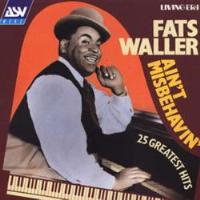
Harlem native Thomas "Fats" Waller
completed the fusion of blues, ragtime and stride piano while also
inaugurating a jazz style at the organ. His compositions of the 1920s, that
constitute a synthesis of all the (secular and religious, white and black)
musical styles he heard while growing up in Harlem, made him
the most famous of the jazz pianists:
the piano roll of Spencer Williams' Got to Cool My Doggies Now (march 1923),
Clarence Williams' Squeeze Me (february 1926),
Messin' Around With The Blues Blue (january 1927),
Rusty Pail and Soothin' Syrup Stomp (january 1927), with a typical pipe-organ solo,
The Whiteman Stomp (may 1927),
the Broadway musical Connie's Hot Chocolates (1929), that included Ain't Misbehavin' and the protest song Black And Blue (both hits for their performer, Louis Armstrong),
his canonical piano solo Handful Of Keys (march 1929),
Valentine Stomp (august 1929),
I've Got a Feeling I'm Falling (august 1929),
Smashing Thirds (september 1929), still reminiscent of ragtime,
Blue Turning Grey Over You (recorded by Armstrong in february 1930).
During the Great Depression he composed conventional ballads such as
Honeysuckle Rose (november 1934) with the studio band The Rhythm
and Keepin' Out Of Mischief (june 1937),
besides The Joint Is Jumping (december 1937)
and the celebrated Jitterbug Waltz (march 1942) with an orchestra,
although
some of his biggest hits were no longer his own compositions, such as
Harry Warren's Lulu's Back in Town (may 1935) and
Fred Ahlert's I'm Gonna Sit Right Down and Write Myself a Letter (may 1935).
But he also continued to craft austere solo compositions/performances, such as
the boogie-woogie Alligator Crawl (november 1934),
the ragtime African Ripples (march 1935),
the mini-suite Clothes Line Ballet (march 1935),
and
the London Suite (june 1939), whose six movements borrowed from a broad range of exotic, classical and jazz styles.
He was one of the most prolific and "poppiest" composers of early jazz.
TM, ®, Copyright © 2003 Piero Scaruffi All rights reserved.
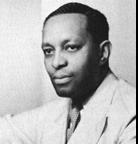
Willie "The Lion" Smith
was the least recorded of the three giants of
stride piano. In fact, he was not recorded until well into the Great Depression,
and his signature songs Finger Buster (january 1939) and
Rippling Waters (january 1939) date from the end of the decade. But he was
probably the authentic stride "animal", living only to display his virtuosity.
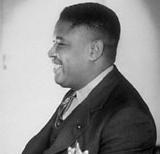
Art Tatum, who arrived in New York in 1932 from provincial Ohio, was the man
who summarized all of their styles, and went beyond.
He very much disengaged jazz piano from the formulas of New York's stride piano
and of New Orleans, and opened up unlimited horizons for it,
although he personally never ventured into the avantgarde, preferring to
stick to his job of ornating the melody with a virtually unlimited
arsenal of tricks.
His dexterity, introducing a degree of improvisation that had not been known
before, resulted not only in a display of piano acrobatics
(he could play the most complex passage at a speed of 400 beats per minute)
but in a much broader vocabulary and a much more expressive language.
He coined the language, but he failed to write the poem: his style was a
baroque infrastructure of embellishments. That colossal apparatus of technique
was tested mainly on brief pop tunes, it was never adequately employed for
a major composition.
Fame and respect came in 1933 with a breakneck version of Nick LaRocca's
Tiger Rag (march 1933), and his first hit came with a solo-piano cover of
Vincent Youmans' pop tune Tea for Two (march 1933).
His repertory would remain of this (very trivial) quality.
He mostly performed solo because his quasi-polyphonal playing almost simulated
a band, and few musicians could play at his speed anyway.
TM, ®, Copyright © 2003 Piero Scaruffi All rights reserved.
Next chapter | Back to the Index
|